Opinion | Algeria’s Confrontation With the UAE Is Strategic, Not Escalatory
- Editorial Team

- 51 minutes ago
- 2 min read
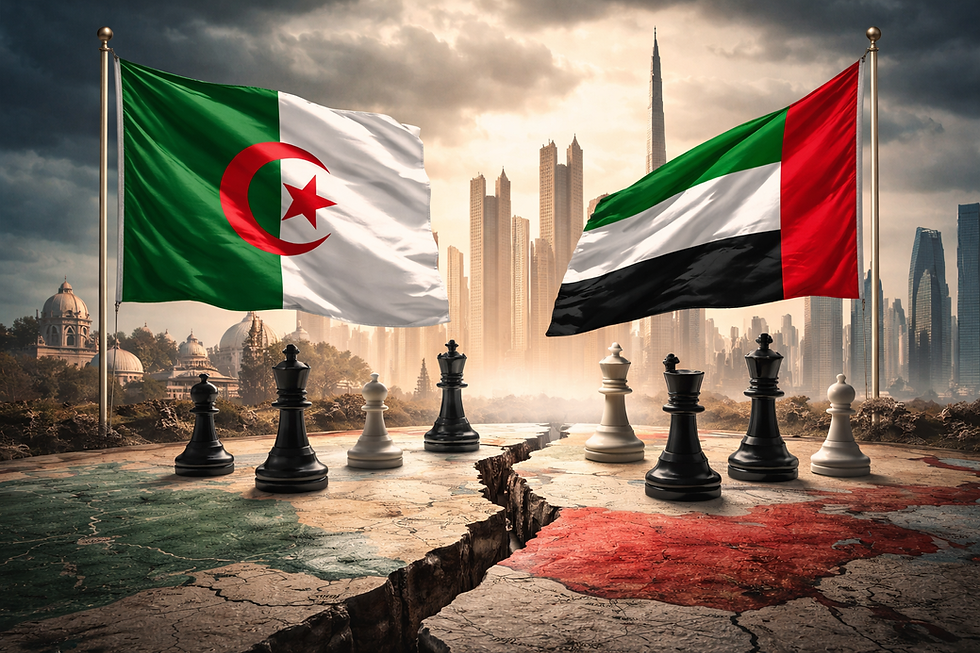
Algeria’s current posture toward the United Arab Emirates is being misread as escalation. It is not. What we are witnessing is a calculated strategy of exposure—designed to neutralize influence, disrupt covert interference, and reinforce Algeria’s diplomatic autonomy.
President Abdelmadjid Tebboune’s recent interview marked a turning point. Its impact extended far beyond Algeria, resonating across Egypt, North Africa, and the broader Arab world. The regional response confirmed a reality many overlook: Algerian presidential discourse has regained strategic weight.
Egyptian President Abdel Fattah el-Sisi’s public expression of gratitude was not ceremonial. In diplomacy, public gestures are signals. His subsequent visit to the UAE strengthened the interpretation that Cairo was positioned as a mediator, acknowledging that Algeria’s stance could no longer be sidelined.
This sequence reveals the core of Algeria’s approach: public hostility as a strategic instrument.
Unlike traditional diplomatic pressure, public hostility targets what the UAE values most—its international image. Abu Dhabi’s influence relies on perception management: media partnerships, lobbying, cultural branding, and carefully curated narratives. Quiet disputes can be absorbed. Open criticism from a sovereign state cannot.
Algeria identified this vulnerability early. By bringing tension into the open, it limits the UAE’s ability to operate through informal channels and proxy influence. This logic was reinforced by Algiers’ decision to suspend air links with the UAE, a move analyzed in Algeria News Gate’s report, “Algeria Suspends Air Links With the UAE, Signaling a Major Diplomatic Escalation.” The suspension was less about punishment and more about clarity.
The same strategic restraint defines Algeria’s position on Western Sahara. Contrary to popular narratives, Algeria did not miscalculate when it avoided direct confrontation with Morocco over normalization with Israel. It avoided a trap—one that would have shifted the conflict from diplomacy to open confrontation.
Today, Algeria occupies its traditional role: observer, not negotiating party. There are no direct Algeria-Morocco negotiations. The Polisario Front negotiates its cause; Algeria supports diplomatically while safeguarding the principle of self-determination. Claims of secret bilateral talks serve only to distort reality.
Morocco’s preference for negotiating directly with Algeria reveals an imbalance of interests. Such talks would dilute the Western Sahara issue by folding in unrelated disputes. Algeria has nothing to gain from that framework—and everything to lose.
Here, the UAE’s disruptive role becomes visible. Public hostility toward Abu Dhabi at this stage is not emotional—it is preventive. It exposes interference, constrains proxy behavior, and protects the negotiation process from backstage sabotage.
This diplomatic posture also aligns with Algeria’s economic vision. The country seeks to become a convergence point for global economic interests, not a participant in rigid military blocs. That ambition requires strategic autonomy, credible diplomacy, and controlled escalation—not silence.
Nothing in this trajectory is accidental. The intensity of public hostility is calibrated against one central variable: national stability. The objective is not confrontation, but containment—weakening destabilizing networks while keeping the region away from war.
Algeria is no longer relying on ambiguity. It is leveraging visibility. And in today’s geopolitical environment, visibility is power.


Comments